

…“Sustainable peace must start from grassroots” – NCA Chair
…Tags “One North, One Voice.”
by Achadu Gabriel, Kaduna
Northern leaders, traditional rulers, security experts, and civil society groups on Wednesday converged in Kaduna for the ‘Arewa Awareness Summit on Unity Against Insecurity,’ with a vow to end the cycle of insurgency, banditry and kidnapping through collective action.
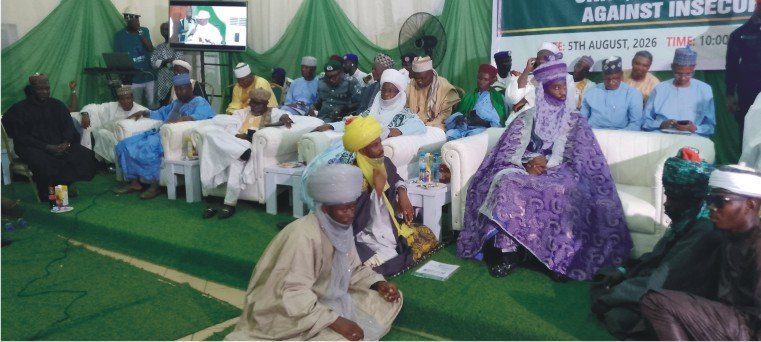
Declaring the summit open at Arewa House, Director-General of the Arewa for Unity, Cohesion and Development Initiative (ACI), Dr. Abdullahi Idris, said the gathering was a “definitive stand of Unity Against Insecurity” and a turning point for the region.
The summit, themed: ‘Unity, cooperation and collective action against Insecurity,’ drew royal fathers, religious leaders, government officials, heads of security agencies, youth and women groups, academia, and the media.
Dr. Idris told delegates that the North could no longer afford silence or blame-shifting in the face of escalating violence.
“For too long, our region has bled under the shadows of insurgency, banditry, and kidnapping. These crises have fractured our social fabric and stifled our potential. We refuse to look away,” he said.
He stressed that participants must shed political, tribal and sectarian divides and meet “as sons and daughters of the North, bound by a shared ancestry and a common destiny. One North, One Voice’ is no longer just a rallying cry: it is our vital imperative for prosperity,” he added.
The ACI DG said the summit was designed as a strategic intervention to transform complaints into actionable solutions and to rebuild trust between communities and the state.
“Our objectives are uncompromising. We will come up with strategies for honest dialogue between communities and the state. We will recommend the best ways to dismantle the drivers of conflict, from economic despair to the erosion of traditional values,” he stated.
He called on traditional and religious leaders to lead reconciliation efforts, and charged youth and women to drive the restoration process.
“To our youth and women: you are the heartbeat of the North. Your energy and vision are the indispensable fuel for this process of restoration,” he said.
Dr. Idris announced that ACI will institutionalize quarterly dialogues and establish a network of Community Peace and Youth Ambassadors to sustain the outcomes of the summit.
“We seek more than eloquent speeches; we seek a tangible, regional Peace and Security Framework that binds us all to immediate action,” he said.
He added that the summit would move from discourse to “deep-dive sessions and conflict mapping” to produce concrete recommendations.
The ACI DG urged participants to commit to a new narrative for the region. “Let this Summit redefine the North, from a narrative of crisis to one of fierce resilience. Let us build a region where children walk without fear, where farmers sow in security, and where every community thrives,” he said.
He pledged that ACI would ensure the summit’s resolutions endure beyond the event. “This is not a moment in time, but the start of a movement,” Dr. Idris declared.
The summit continues with panel discussions and working groups aimed at producing a regional action plan on peace and security, and attended with creams of personalities, including Emirs, gubernatorial candidate, among others, from across North.
Speaking in an interview on the sidelines of the summit, Chairman of the Northern Christian Association (NCA) Rev. Joseph John Hayab, said sustainable peace must start from the grassroots.
“So, we have to promote or encourage local contribution, local initiative, local involvement in the peace process because, if we think that it’s the governor that will give us peace, he’s probably busy doing another thing. If we think it’s the senator or the president, he’s possibly chasing another thing,” he said.
“Before the governor will come to our local community, we will solve our problem, we will find solutions to our problem; then, we can now hold them responsible and remind them that, “hey, that security vote has no need again,” because we are at peace; so, use it and repair our house, use it and repair our road, use it and repair our hospital.”
Rev. Hayab decried what he called “high class conversations” that exclude victims, stressing that dialogue must be brought to communities to understand their real needs.
“When those, who are not victims, are discussing for victims, they don’t know the needs of victims. If you bring the conversation to local communities, you will now know their needs,” he added.