

by Christiana Gokyo, Jos
JOS: The Commissioner for Transport, Plateau State, Hon. Davou Jatua Gyang, has disclosed that “The Vehicle Inspection Office (VIO) is not a revenue-generating agency. Revenue generation is not its sole responsibility, because that is not their duty, and we should cast our minds away from the revenue-generating aspect.”
He disclosed that, when VIO officials accost any one on the road and establish that the person is not complying with traffic laws, they may be required to pay a fine.
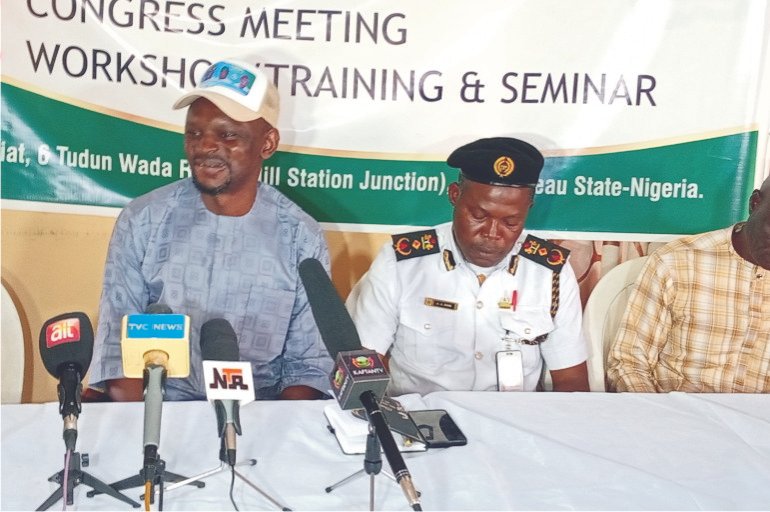
The Commissioner disclosed this on Wednesday at the NUJ Press Center Jos, during an interactive session with Journalist, saying, “Fines are punitive. They are meant to make people feel the consequences of violating the law and encourage them to do the right thing to avoid another fine.
“The VIO may collect the fine, but it is remitted to the appropriate government office, just as fines imposed by the courts are handled. So, the VIO is not on the road primarily for money. Its responsibility is to check compliance, inspect vehicles and ensure that vehicles on the roads are roadworthy,” he noted.
According to him, “Tricycles and vehicles are different: ne has four wheels, while the other has three. By law, tricycles have designated routes that they are expected to ply.
“They are not supposed to be found on major roads, highways or Trunk ‘A’ roads. Tricycles are supposed to operate on Trunk ‘B’ roads and roads leading into communities, rather than highways. Highways are primarily meant for four-wheel vehicles,” he disclosed.
Hon. Gyang further explained that, “Having tricycles on such roads is an aberration of the law. We are also working on modalities in line with the government’s vision of introducing electric vehicles. We are going beyond physical or manual enforcement.
“We are working towards geographical fencing, which will be electronic. Once such a system is in place, a vehicle can be prevented electronically from extending beyond a designated boundary,” he stated.
“While we are also considering ‘time fencing’ – If, for instance, tricycles are legally allowed to operate, from 6am to 6pm, once it is 6pm and the tricycle is still operating, the system could prevent it from continuing. It would essentially lock the vehicle from operating beyond the permitted time or geographical boundary,” the Commissioner disclosed.
He stressed that, “This intention is to strengthen the security architecture of the streets, because people have gone beyond their designated boundaries and used various modes of transportation to perpetrate illegal activities.
“Many crimes committed on the streets involve mobility, whether we like it or not. These are some of the things the governor wants to check and curtail, and we are already at an advanced stage in working out these measures.”
Hon. Davou Jatua Gyang further emphasized that, “On roadworthiness, we have a platform at the VIO testing ground where you can take your vehicle for inspection.
“The machine scans the vehicle and can identify issues such as tyre condition, engine oil levels and other aspects of the vehicle’s functionality. It provides a report on the condition of the vehicle. So, we do not simply collect money for roadworthiness.
“The idea is for you to take your vehicle to the mechatronic platform, have it scanned and receive an automated assessment. The result is not manipulated by humans. It is based on what the machine scans and detects,” he said.
According to him, he has advised many colleagues to take their vehicles there to ascertain what may be wrong with them, and also seize the opportunity to advise owners of private vehicles that, sometimes, they may not know what is wrong with their vehicle to take it there and have it scanned. The cost is about ₦2,500.
The Commissioner further emphasized that, that is why VIO officials also conduct physical checks on the road to ensure that vehicles have the basic safety accessories required by law, one major accessory being a fire extinguisher.
He also urged every vehicle owner, bus operator and taxi driver to have one in their vehicle. In the event of a fire, they do not have to start looking for sand or other materials, adding that a fire extinguisher can help contain the fire at an early stage.
He pointed out that, VIO officials also check compliance with vehicle particulars. By law, vehicle particulars are renewed yearly, while commercial vehicles are required to undergo roadworthiness certification twice a year because they are used more frequently for commercial purposes. Their wear-and-tear is, therefore, faster than that of private vehicles.
But he noted that, “The FCT VIO judgment does not affect Plateau. The law governing the operations of VIO is domesticated. VIO has a national presence across the states, but its operations are domesticated in each state. Every state has its own peculiar laws governing VIO operations.
“The recent judgment concerning VIO operations in the Federal Capital Territory is specific to the FCT. It does not affect VIO operations in Plateau State or other states of the federation. VIOs continue to operate across the 36 states of the federation.
“So, as far as Plateau State is concerned, there is no judgment banning or prescribing the operations of VIO here.
“If anyone has such a judgment, I want to see it. Give me the judgment and I will come back and show the world whether it actually affects VIO operations in Plateau State and other States,” he stated.
On extortion and misconduct by VIO officials, the commissioner further stated that “Extortion is criminal in nature. Any time you find someone in a VIO uniform engaging in such conduct, report the person to me. We will prosecute. We will first apply the Civil Service disciplinary procedures.
“Afterwards, if it is a case of extortion, which is criminal in nature, the person will also be prosecuted. From this day forward, help us as watchdogs of society. Do not relent in reporting such cases to us.
“We want to withdraw VIO officers, who have such attitudes, because we cannot continue to allow one person’s behaviour to damage the image of the state and the organisation. One person with such an attitude can completely damage the reputation of all the officers.
“We know that people have had both good and bad experiences with VIO officers.VIO officers are human beings and officers of the law, who have been designated to perform certain duties on the roads,” he stressed.
Hon. Davou Gyang also hinted that, “The suspension of VIO activities, which was announced by the management of the ministry last week, following the two incidents – one at Constitution Hill and another along Ahmadu Bello Way – involving people physically assaulting officers who were performing their duties, was necessary to allow these engagements to take place so that we can understand what the public thinks, identify what needs to be corrected and address the challenges.
“We are reviewing our previous operations to determine how best to make our approach more holistic. When we return to the field, you may not immediately see VIO officers standing at every point on every road at the same time. We are likely to resume with a new pattern,” Davou Gyang stated.