

by Achadu Gabriel, Kaduna
A group, known as, ‘Step-Up Nigeria,’ has renewed calls for the enactment of a comprehensive Whistleblower Protection Law in Nigeria, urging the Federal Government to provide stronger legal framework to safeguard citizens, who expose corruption, misconduct, and unethical practices.
The call was made during a media roundtable organized by Step-Up Nigeria, in partnership with the Platform to Protect Whistleblowers in Africa (PPLAAF), as part of activities commemorating the 2026 World Whistleblower Day Art and Media Competition.
Speaking at the event, the Director of Programmes at Step-Up Nigeria, Mrs. Feranmi Iyanda, expressed concern over the continued absence of what she described as a “dedicated legal framework” protecting whistleblowers in Nigeria, despite the existence of a whistleblower policy introduced in 2016.
According to her, the lack of statutory protection exposes individuals who report corruption and wrongdoing to intimidation, victimization, and retaliation.
“Everything we are advocating here is for the law to protect whistleblowers. We want to have a whistleblower protection law in Nigeria,” she said.
“There is currently no whistleblower protection law that clearly mandates protections for whistleblowers in Nigeria. Across the entire African continent, only eight countries have enacted whistleblower protection laws, which shows there is still significant work to be done,” she said.
The media roundtable brought together anti-corruption advocates, media practitioners, civil society stakeholders, students, and young creatives to discuss the importance of whistleblowing, transparency, accountability, and citizen participation in strengthening democratic governance.
Representing the Independent Corrupt Practices and Other Related Offences Commission (ICPC), Mr. Suleiman Achile, Deputy Director of the Civil Society Mobilisation Unit, highlighted ongoing efforts by the Commission to build a culture of integrity among young Nigerians.
Speaking through Dr. Babasola Oluwasina, Deputy Director of the Education Department, Achile explained that the Commission has established Anti-Corruption Clubs in secondary schools and Student Anti-Corruption Vanguards in tertiary institutions across the country.
“The ICPC has developed several youth engagement programmes focused on integrity and accountability. At the secondary school level, we have Anti-Corruption Clubs, while in tertiary institutions we have Student Anti-Corruption Vanguards.
“These initiatives are designed to equip young people with the values of honesty, integrity, and accountability so they can become responsible citizens and ethical leaders wherever they find themselves,” he said.
He further noted that the Commission is implementing the National Ethics and Integrity Policy as part of broader efforts to strengthen ethical standards and promote responsible conduct across all sectors of society.
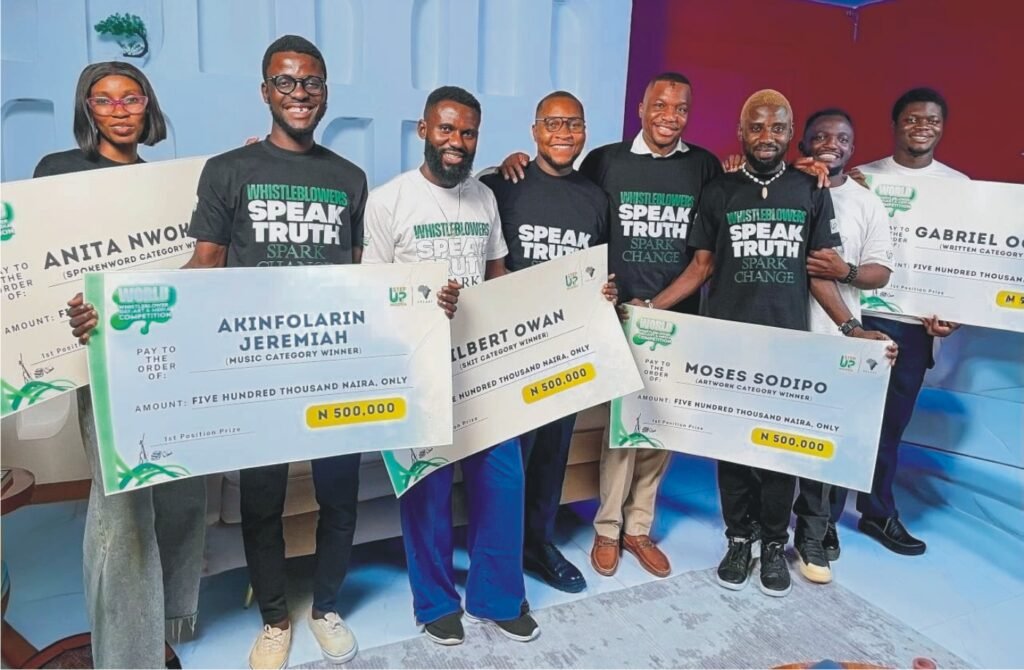
A major highlight of the event was the 2026 World Whistleblower Day Art and Media Competition, which provided a platform for young Nigerians to use creativity and storytelling as tools for advocacy.
According to the Communications Manager of Step-Up Nigeria, Dr. Shekwogaza Kure, the competition was designed to amplify youth voices and encourage conversations around whistleblower protection, anti-corruption, transparency, accountability, and responsible citizenship.
“The competition was created to provide young Nigerians with a platform to use art and media as instruments for social change. It encourages critical conversations around whistleblowing, transparency, accountability, and the urgent need for stronger legal protections for whistleblowers in Nigeria,” Kure stated.
He disclosed that the competition attracted 172 entries from across the country, comprising 111 male participants and 61 female participants, demonstrating growing youth interest in governance and anti-corruption advocacy.
“Winners emerged from various categories, including music, skits, poetry and spoken word, artwork, and digital media.
“The overall winners received cash prizes of ₦500,000 each, while runners-up received ₦200,000 each in recognition of their outstanding advocacy contributions,” he stated.
The category winners included Gilbert Owan (Skits), Damilola Akinfolarin (Music), Anita Nwokoji (Poetry and Spoken Word), Moses Sodipo (Artwork), and Oguche Onuche.
Speaking on behalf of the winners, Anita Nwokoji urged Nigerians to reject silence in the face of corruption and wrongdoing.
“Wrongdoing is wrongdoing, whether it occurs in the workplace, in our communities, in schools, religious institutions, or any other environment. People must be willing to speak up whenever they witness corruption or misconduct,” she said.
Participants at the roundtable emphasized that corruption is not limited to government institutions alone but can exist in homes, businesses, schools, religious organizations, and communities. They stressed that promoting integrity and accountability requires collective action from all citizens.
The event concluded with renewed commitments from civil society organizations, media professionals, youth leaders, and anti-corruption advocates to continue championing whistleblower protection reforms and fostering a culture of transparency and accountability across Nigeria.
The World Whistleblower Day Art and Media Competition forms part of Step-Up Nigeria’s broader mission – to “empower citizens, especially young people, to become active champions of integrity, good governance, and social accountability.”